


If you own a roofing franchise and want to learn from a proven digital marketing strategy that contributed to an impressive $57.1M in annual revenue, you’ll love this case study.
Mighty Dog Roofing, a leader in both residential and commercial roofing, began franchising in 2020 following its acquisition by Horse Power Brands. Since then, the company has rapidly expanded to over 50 franchises across the United States.
About a year after the acquisition, Mighty Dog Roofing started investing heavily in organic marketing, which significantly increased its search visibility and revenue.
The results so far have been remarkable: 20,000 monthly organic traffic valued at $128,000 in just three years.
Below, we break down Mighty Dog Roofing’s marketing strategy, exploring how they built an SEO moat that has delivered a significant return on investment for the brand.
We also share actionable tips you can apply to achieve similar results.
How Mighty Dog Roofing drives $128,000+ worth of organic traffic using franchise SEO and content marketing
Organic search is Mighty Dog Roofing’s biggest traffic source, bringing in nearly 20,000 visitors each month. And here’s the best part—that’s traffic worth $128,000 in paid ads, but they’re getting it for “free.”
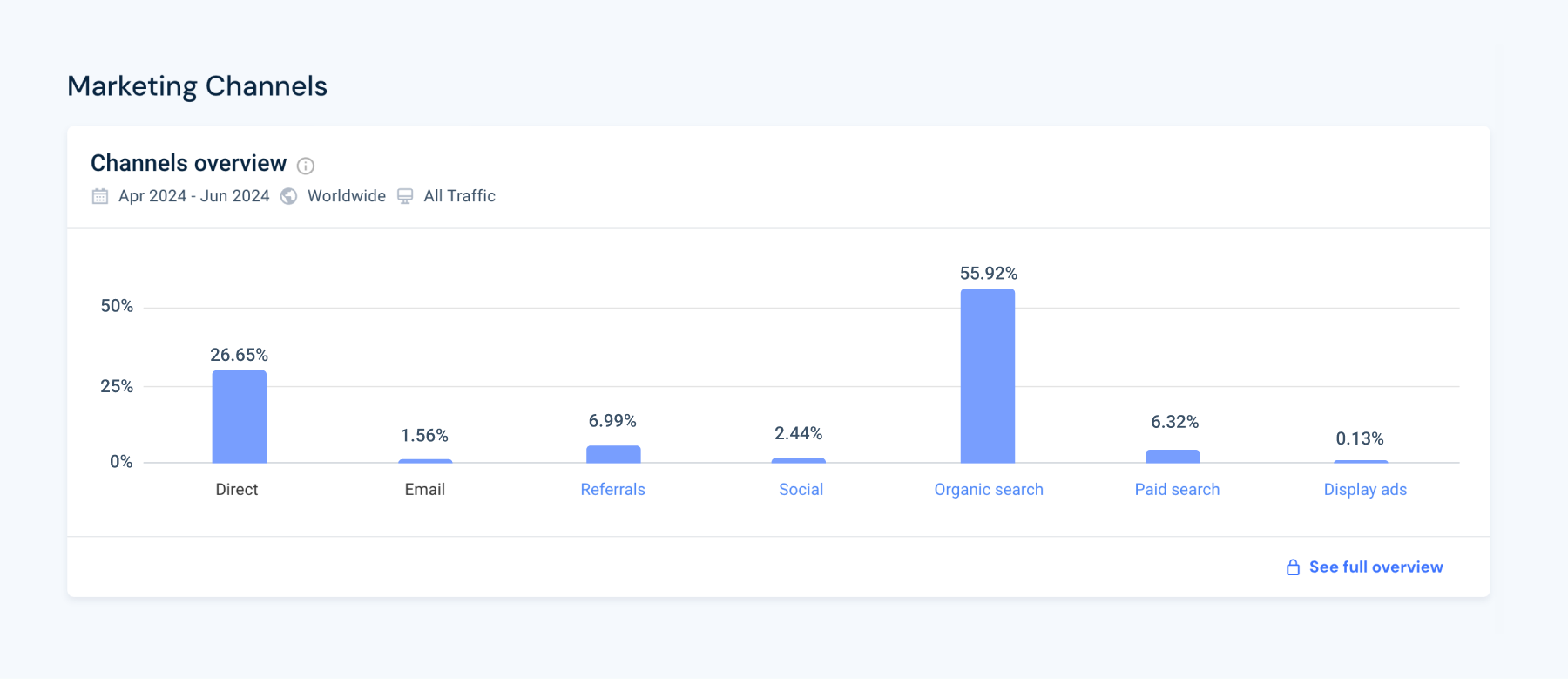
This impressive traffic is a direct result of their strategic approach to franchise SEO and content marketing.
Let’s break down these two key pillars to see how they work together to boost visibility online and drive growth across all franchise locations.
1. Mighty Dog Roofing franchise SEO strategy – optimizing for local visibility
Franchise SEO goes beyond making the main brand’s website visible; it ensures each franchise appears in search results when people in that area are looking for roofing services.
The primary website (which is usually the company’s home page) is optimized for broader, general search terms that represent the business as a whole. For instance, Mighty Dog Roofing ranks in the top three local results on Google Maps for “roofing contractor,” a highly competitive keyword with 33,000 searches every month.
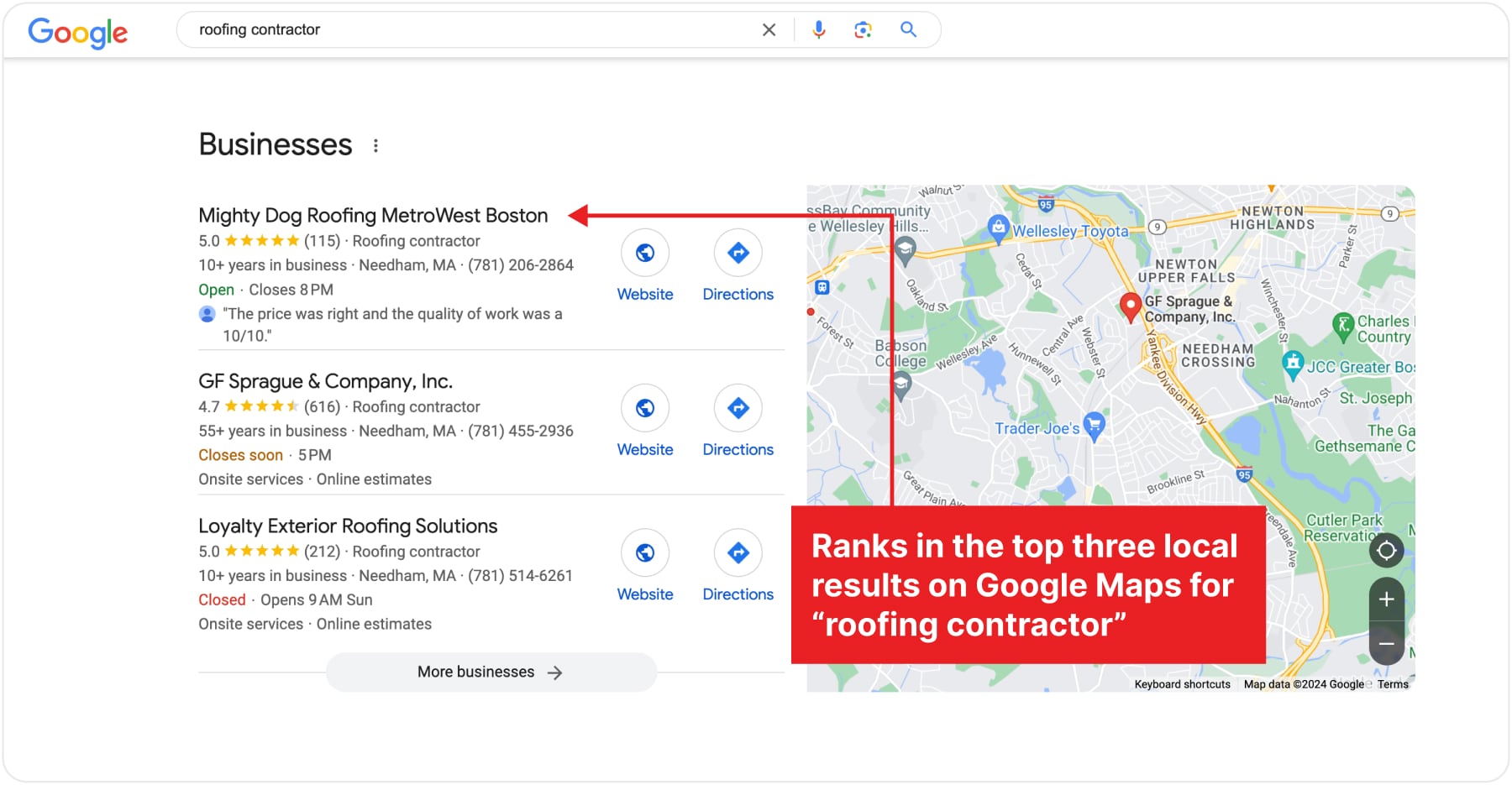
Ranking high for such a keyword indicates that Mighty Dog Roofing’s Google Business Profile is thoroughly optimized.
To make this possible, Mighty Dog Roofing filled out every section of their Google Business Profile, including critical details like business name, address, phone number, and website.
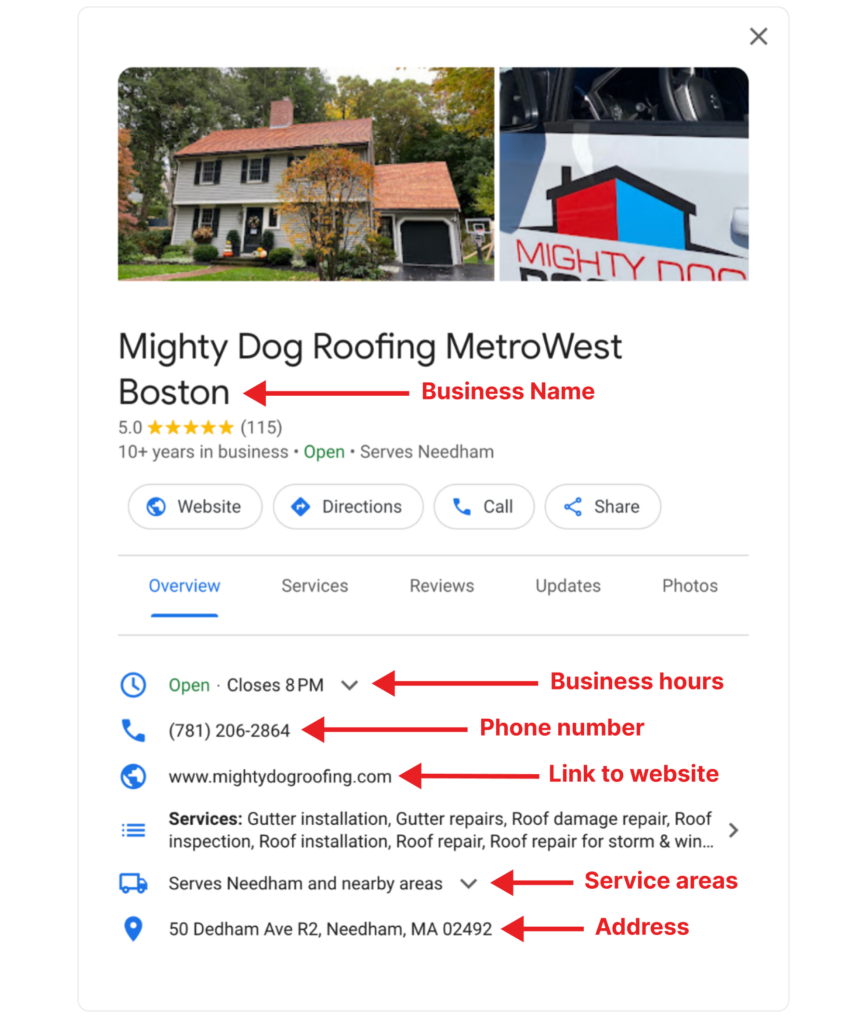
Accuracy in these details is crucial for local SEO, as it helps Google understand more about your business and improve your ranking for local searches.
Plus, it increases its chances of capturing high-intent leads. Customers are 70% more likely to visit and 50% more likely to consider hiring businesses with a complete Business Profile.
Pro Tip: Ensure each franchise has its own Google Business Profile that is fully completed with accurate and detailed information, including business name, address, phone number, and a link to a dedicated landing page on your main website. This individual attention to detail at each location will improve their local search rankings and attract more relevant traffic.
Apart from a complete profile, your business description, services, and even update posts should include your target keyword naturally, if possible. Mighty Dog used the ‘roofing contractor’ keyword in all the places we mentioned above.
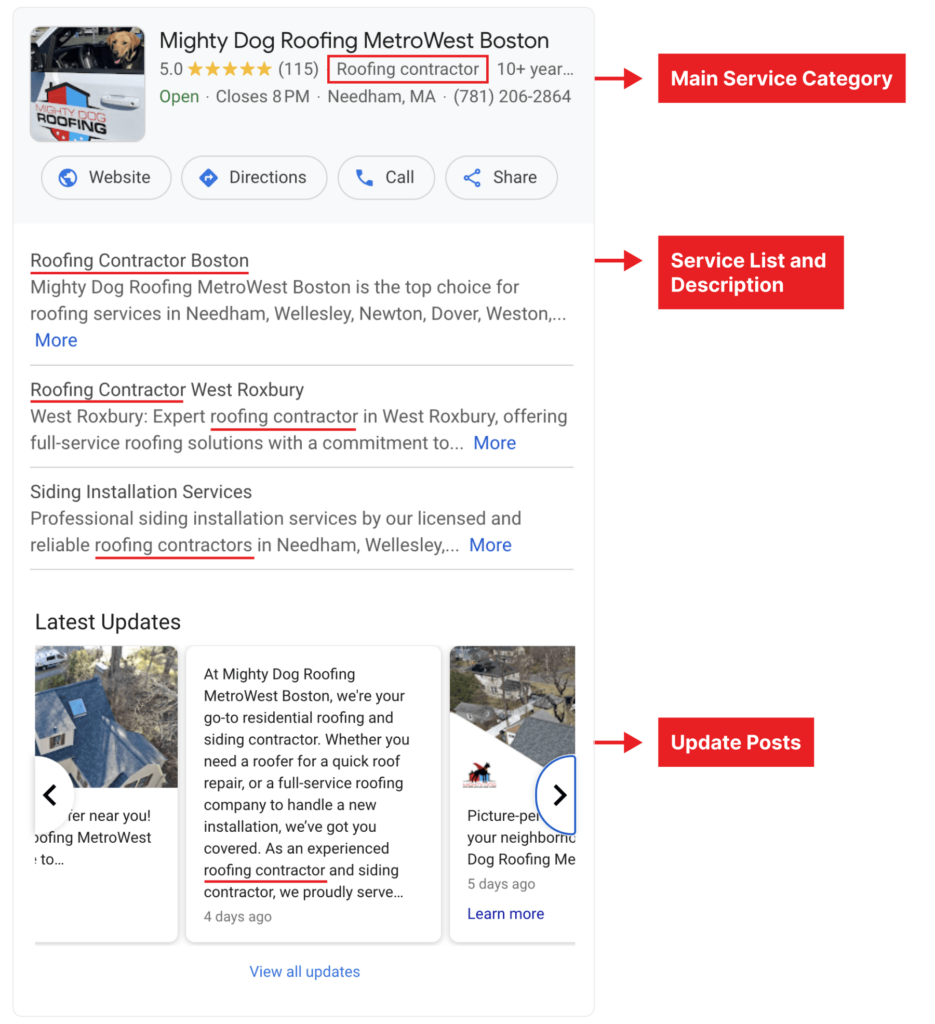
When you include target keywords in your profile content, it signals to Google what your business specializes in. This helps Google understand the context of your business and aligns your profile more closely with those search terms.
For example, using “roofing contractor” consistently tells Google that Mighty Dog Roofing is relevant to people searching for roofing services.
Plus, using this keyword and related terms prominently on your profile makes your GBP more likely to catch the attention of potential customers who need your services.

Need help creating and optimizing your franchise’s main Google Business profile (as well as the individual profiles for each location) to rank higher on Google Maps?
Follow the steps in this guide or book a free consultation so we can work together to position your brand to rank on Google Maps and attract the qualified leads you desire.
The website link on Mighty Dog Roofing’s Google Business profile takes you to its main landing page, where you’ll notice one thing that’s crucial for franchise brands.
Each franchise location has its own landing page within the main website, and the call-to-action buttons on the hero section and main menu lead you there:

Since the home page itself drives more than 20,000 monthly visits, placing the “Find a Location” button in its hero section and menu:
- Reduces user friction in the customer journey.
- Lets visitors easily and quickly find the franchise closest to their location.
- Allows prospects to contact the business or schedule a service appointment.
The individual franchise pages leverage the home page’s high traffic, turning the page into a traffic and lead-generation tool for all locations.
This approach has led to notable results, with individual landing pages like Mighty Dog Roofing’s South Charlotte page receiving over 100 monthly organic visits and its Metrowest Boston page getting up to 220 monthly organic visits.
These pages are also optimized for location-based keywords, so when someone searches for a service in their area, they’re directed to the page of the nearest franchise.
For example, Mighty Dog Roofing’s Fort Worth page ranks #1 for ‘siding repair Fort Worth,’ a commercial keyword with an estimated monthly search volume of 60.
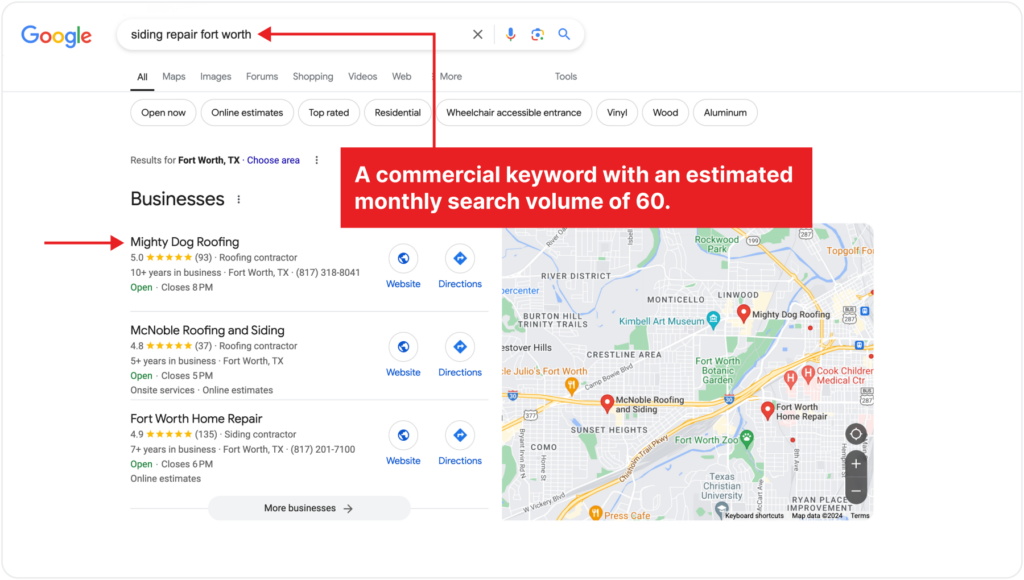
Even though the monthly search volume is modest, those searching for this specific keyword are likely in the final stages of making a decision.
They have a clear need (siding repair) and are specifically looking for services within their geographic location (Fort Worth), making this traffic highly targeted and likely to convert into real business for Mighty Dog.
Also, dominating the local map pack reduces over-reliance on paid advertising.
With the average cost per click for this keyword being US$18.06, ranking organically saves Mighty Dog Roofing significant advertising costs.
Instead of spending on costly clicks to attract leads, the roofing company can redirect those resources towards enhancing service quality, improving customer support, or expanding operations into new areas.
How to implement
- Ensure each franchise’s Google Business Profile is fully complete with your business name, address, phone number, and a link to its own page within your main website.
- Use service keywords, such as “roofing contractor,” across various sections of your GBP, including the business description, service listings, and regular posts.
- Develop individual landing pages for each franchise within your main website and optimize them for local search terms relevant to their specific geographic areas.
- Utilize the high traffic driven to your main homepage by prominently featuring a “Find a Location” button in both the hero section and main menu.
- Ensure individual franchise landing pages provide detailed service information and clear calls to action (CTAs) like “Contact Us” or “Schedule a Service.”
Mighty Dog Roofing content marketing strategy — building trust and credibility.
Mighty Dog Roofing receives more than 7,000 monthly visits from its blog. That’s more than three-quarters of its total website’s monthly organic search traffic.
The company retains spots in the top three search results for 60+ keywords, including:
| Search Term | Monthly Search Volume | Monthly Traffic |
|---|---|---|
| Roof flashing types | 1,000 | 248 |
| Roof rat droppings | 880 | 218 |
| Roof rat poop | 720 | 178 |
| Roof moss removal | 4,400 | 154 |
| How to get rid of moss on roof | 1,900 | 2,400 |
Since the top three Google search results receive 54.4% of all clicks, people searching for these queries are three times more likely to click on Mighty Dog Roofing’s blog posts than on those ranked 4th to 10th spots.
These keywords have one thing in common: informational intent.
Informational intent refers to searches where the user is looking for information, answers to questions, or guidance on solving a particular pain point.
Unlike transactional or navigational intent, where the goal is to purchase something or find a specific website, informational intent is purely about gathering knowledge.
Homeowners searching for “roof flashing types,” “roof rat droppings,” “roof moss removal,” and similar phrases want specific information to help them understand and solve a problem.
To address the search intent for these keywords, Mighty Dog Roofing creates in-depth how-to guides that offer step-by-step instructions and answer related questions they have.
Why create how-to guides over other top-of-the-funnel content like listicles?
- To drive more traffic to your site—search engines like Google rank content that satisfies search intent higher than those that don’t
- To position your roofing company as an authority on the subject—how-to guides directly answer the user’s query and provide detailed step-by-step instructions.
- To build client trust early in their journey and increase the likelihood of them hiring your services when they need professional help
For instance, Mighty Dog ranks #2 on Google’s organic search results for the keyword ‘how to get rid of moss on roof,’ which attracts 1900 searches every month.
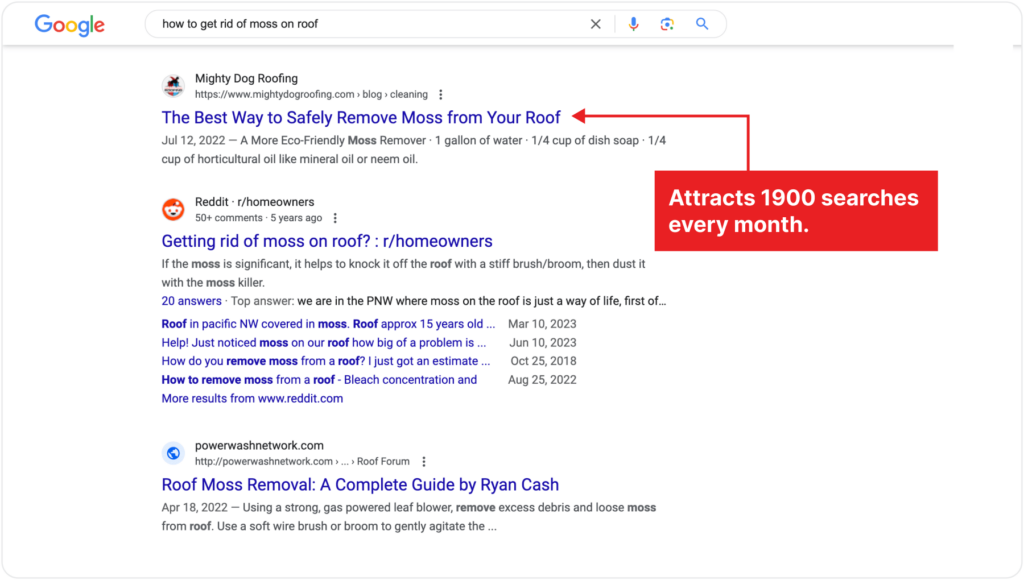
Let’s dissect this piece to see why it ranks in the top results (and even above the r/homeowners subreddit) for the long-tail keyword and attracts 2400 clicks each month.
2. The blog post is optimized using semantic keywords
Semantic keywords are terms and phrases that are related to your primary keyword. They might not be direct synonyms but are associated with the topic you’re covering.
They help search engines like Google understand the full context of your content.
For example, Mighty Dog’s blog post is about roof moss removal, so they included related terms like ‘moss on roof shingles,’ ‘roof moss treatment,’ and ‘moss killer for roofs.’
Since Google uses semantic analysis to understand search queries and provide more relevant results to users, adding these related keywords to your content signals to the search engine that your content covers the broader topic comprehensively.
These keywords help you cover different aspects of a topic, making your content more informative and useful to readers.
The moss removal blog post, for example, answers various questions a typical homeowner has about the topic.
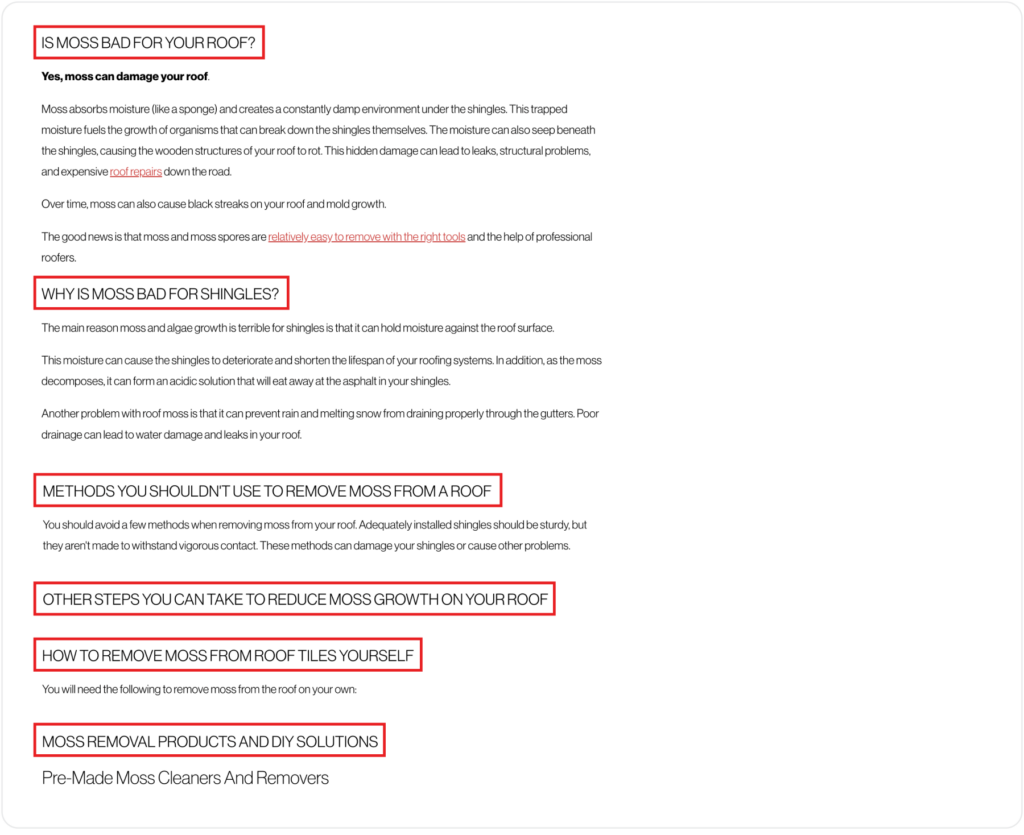
The blog not only explains how to remove moss but also why moss is harmful, what tools to use, and how to prevent future growth.
This comprehensive coverage makes the content more valuable and satisfying for the reader, making them more likely to spend time spent on the page, which are positive signals to search engines that the content is high quality and relevant.
Plus, using related keywords helps your blog post rank for multiple search terms beyond just the primary keyword. This same blog post appears in the top three search results for 46 other keywords, including:
| Search Term | Monthly Search Volume |
|---|---|
| Roof moss removal | 4,400 |
| How do you get moss off a roof | 210 |
| Clean moss from roof | 1,300 |
How to implement
- Determine the main keyword or phrase for which your content will rank.
- Use keyword research tools like Google Keyword Planner, SEMrush, or Ahrefs to find related terms that users often search for (related to your primary keyword).
- Incorporate these related terms throughout your content in a way that feels natural and helpful (in your headings, subheadings, and within the body of your text).
- Structure your content to address various related subtopics; this helps with keyword placement and ensures that your content is comprehensive.
3. A clear, actionable metadata and on-page SEO
Mighty Dog Roofing uses the same wording for both its meta and on-page titles that’s clear, actionable, and includes the keyword “remove moss from your roof.”
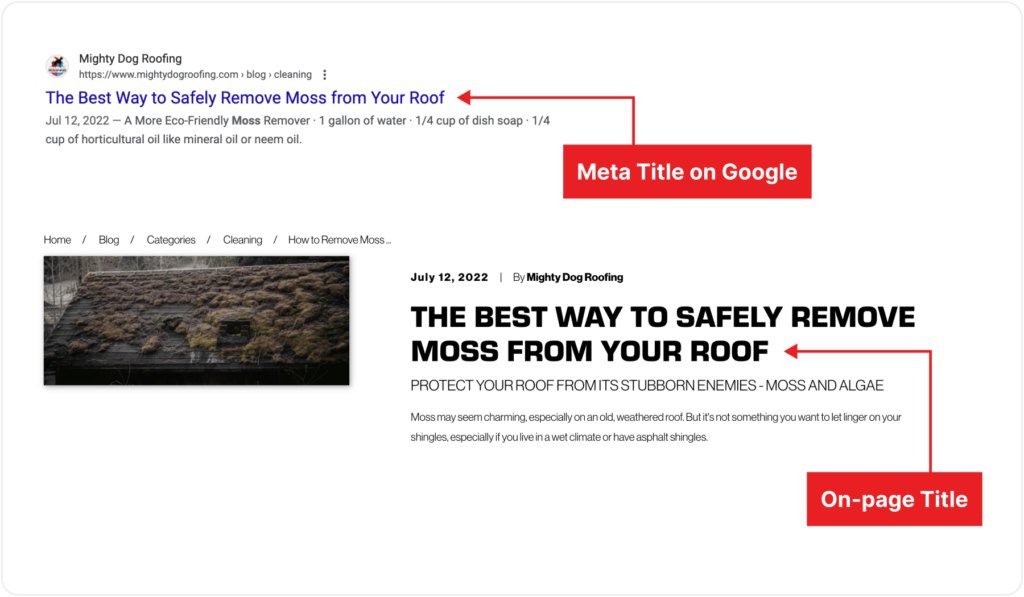
When users see a title that matches their search query, especially in the top results, they are more likely to perceive the content as relevant and click to read it.
The inclusion of the word “safely” addresses a common concern among homeowners—how to remove moss without damaging their roof or putting themselves at risk.
Safety is a significant factor for many users, especially when it comes to DIY tasks that involve potential hazards (which is what this blog post offers—DIY tips).
The subheadings also fulfill the promise the title offers. They organize the content into manageable sections, each addressing a specific aspect of moss removal, such as the risks involved, the correct methods to use, and preventive measures.
For example, the subheading “how to remove moss from roof tiles yourself” leads with telling the reader the kind of equipment they’ll need to do the job themselves.
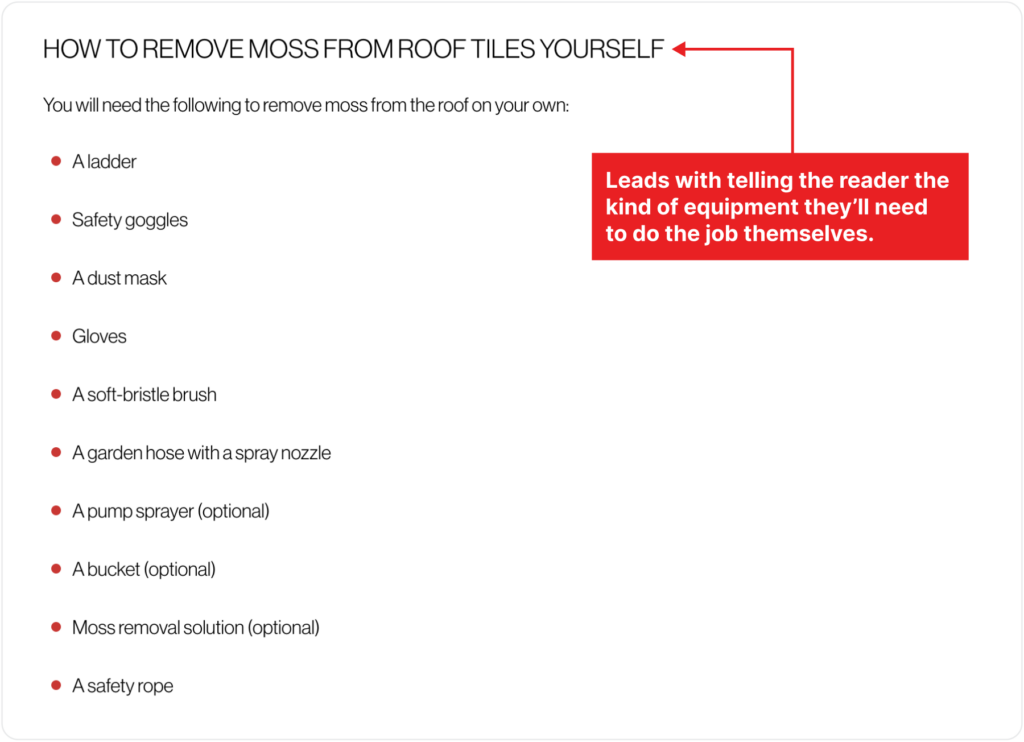
Providing an equipment list upfront makes the content more practical and actionable, ensuring they are all set up to do the job without having to pause halfway. Then, Mighty Dog provides a step-by-step guide to start and complete the actual job.

The step-by-step guide breaks down the process into manageable, clear instructions, ensuring that readers understand exactly how to use each tool at the appropriate stage of the moss removal process.
Breaking down the process makes the content more digestible and actionable, so readers can easily follow along and apply the information to their own situations.
How to implement
- Make sure your primary keyword, such as “remove moss from your roof,” is included in both the meta and on-page titles.
- Ensure your titles clearly state what the content offers and entice users to click.
- Organize your content into sections that make it easier for readers to navigate and find the information they need.
- Make your subheadings descriptive enough to give readers a clear idea of what each section covers and help search engines understand the relevance of your content.
- Break down complex tasks into simple, clear steps; ensure that each step is easy to follow and includes detailed instructions on how to use the tools mentioned.
- Always highlight safety precautions (where necessary); this reassures the reader and addresses concerns that could keep them from attempting the task.
Ready to optimize your local SEO and boost your franchise’s visibility?
4. A clear call-to-action (CTA)
After providing actionable DIY tips, Mighty Dog wraps up the blog post with a clear offer: asking them to contact the team if they are unable to do it themselves.
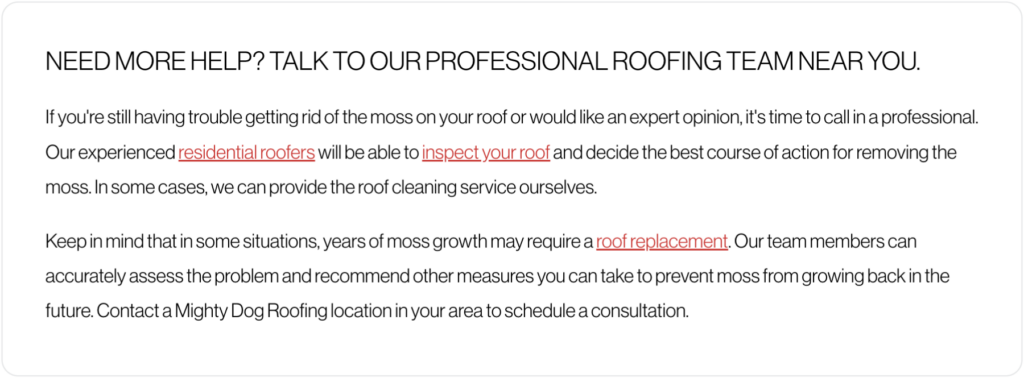
Here’s why this works:
The blog post is likely to attract a wide range of readers, including those who are initially interested in DIY but might ultimately consider professional help.
The blog post will likely attract a wide range of readers, including:
- Inexperienced DIYers: individuals who start with the intention of doing it themselves but may realize the task is more challenging than they anticipated.
- Cautious homeowners: those who are concerned about safety and the potential risks of DIY roof work and who prefer to hire a professional from the outset.
- Cost-conscious readers: those comparing the cost and effort of DIY versus hiring a professional service, who might be swayed by the convenience of professional help.
- Busy homeowners: those interested in maintaining their home but lack the time to take on the project themselves, making professional services more appealing.
Inviting readers to contact the Mighty Dog Roofing team provides an immediate solution and a clear next step for those considering professional help.
By first offering valuable, actionable advice, you establish credibility and trust with the reader. When you then offer your services as an alternative, it feels like a helpful suggestion rather than a hard sell.
This approach can make readers more comfortable reaching out for professional assistance, as they’ve already experienced your expertise and trustworthiness through the content.
How to implement
- Place the CTA at the end of your blog post after you’ve provided valuable, actionable content; this ensures that readers have already gained something from your post and are more receptive to your offer.
- Use clear, direct language that tells the reader exactly what they should do next—be specific about what action you want them to take. For example, “Need help removing moss from your roof? Contact our experts today for a free consultation.”
- Explain why contacting your team is the best next step—clearly mention the benefits of choosing your service.
- Make it easy for readers to contact you by providing multiple ways, such as a phone number, email address, contact form, or even a link to schedule an appointment.
Combine franchise SEO and content marketing to boost local visibility
Whether you’re looking to replicate their success in your own franchise or improve your overall marketing approach, the key takeaway is clear:
Invest in optimizing each franchise location’s Google Business Profile and creating location-specific landing pages.
These ensure that each franchise ranks highly in local search results, drives targeted traffic, and generates high-quality leads.
Also, create in-depth, informational content that answers common questions and addresses customer pain points. They help you establish authority in the roofing industry and capture valuable search traffic.
If you’re ready to take your roofing business to the next level, start by implementing these proven strategies. And remember, success doesn’t happen overnight—but with consistency and the right approach, you can achieve remarkable results just like Mighty Dog Roofing.